
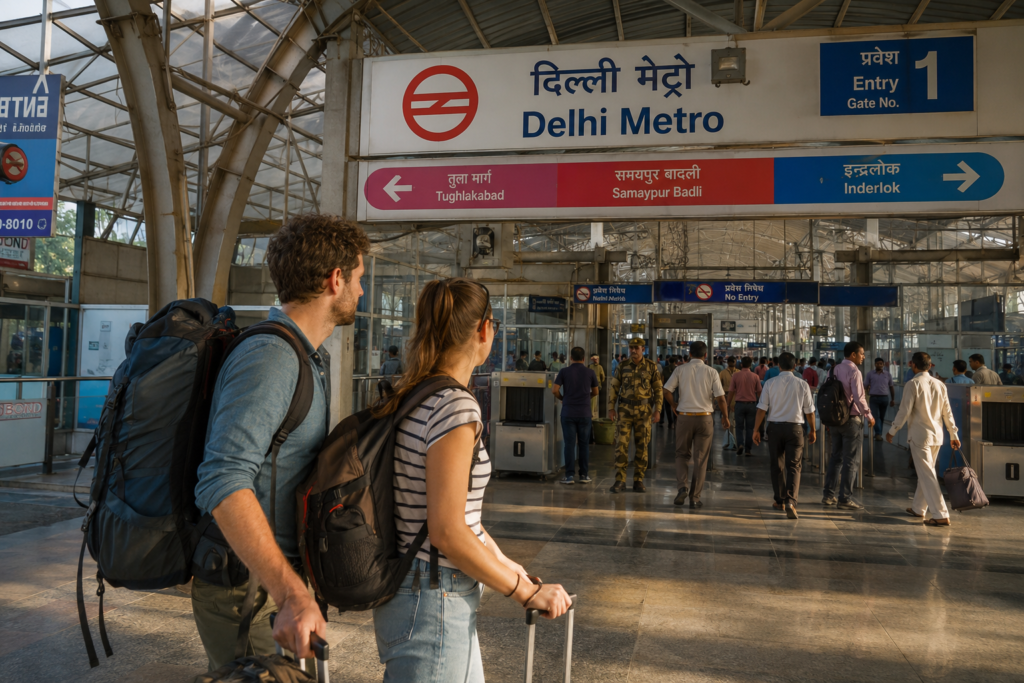
For most first-time visitors, Delhi feels immediately overwhelming. The roads are loud, auto drivers quote prices that bear no relationship to distance, and figuring out which cab app actually works takes time you might not have. The metro changes that. Once you understand how it works, it becomes the most reliable, affordable, and practical way to move around the city, regardless of traffic, time of day, or how unfamiliar the neighborhood feels.
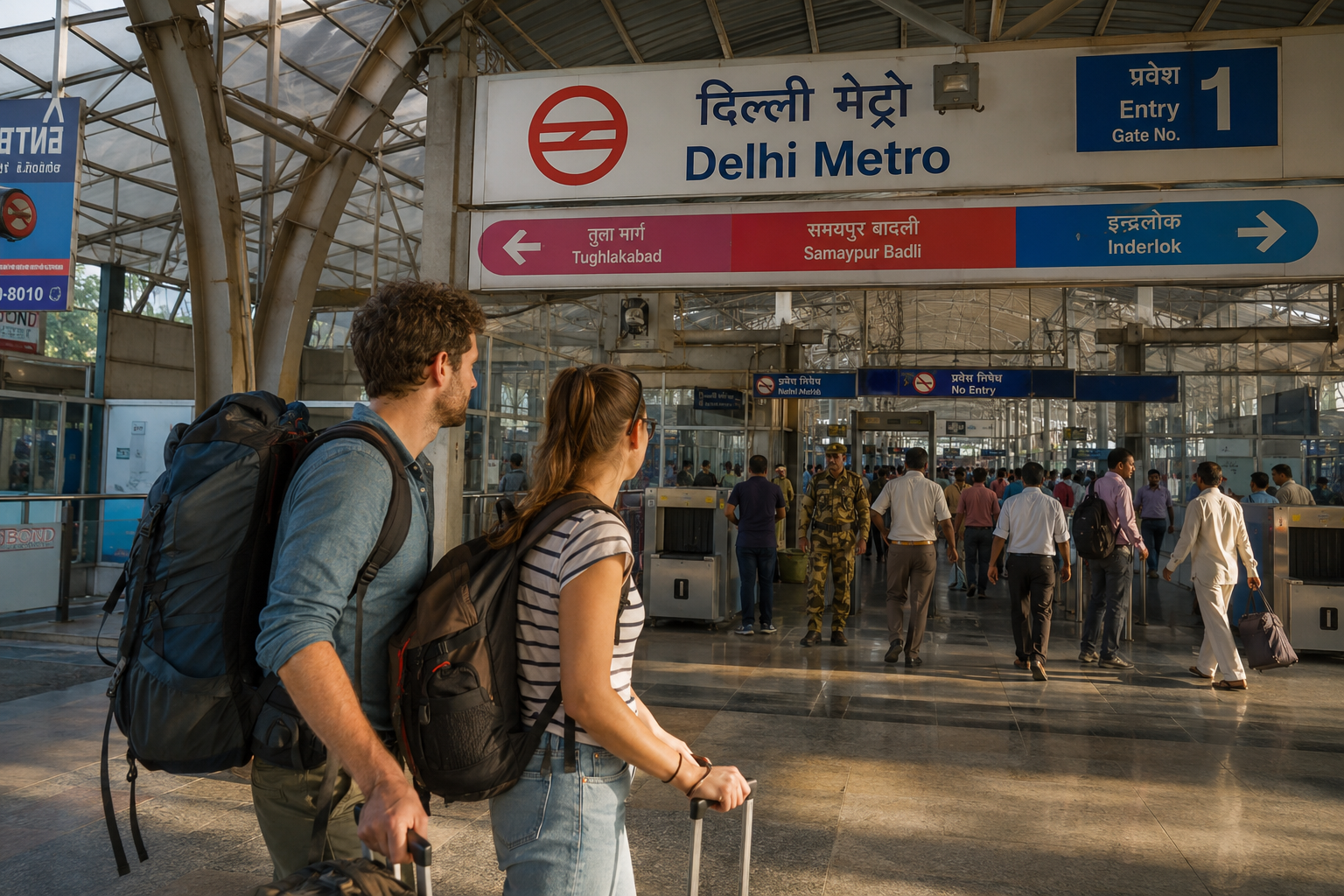
This guide walks you through everything you need: buying tickets, understanding the color-coded lines, getting from the airport, staying safe, and knowing which stations actually put you near the places you want to see.
What the Delhi Metro Actually Is
The Delhi Metro Rail Corporation (DMRC) runs a network of 10 color-coded lines covering over 348 km and 225 stations across Delhi and parts of Noida, Gurgaon, Faridabad, and Ghaziabad. It’s one of the largest metro systems in the world by route length, and it operates cleanly, reliably, and with English signage throughout.
The trains are air-conditioned. The stations have security checks at every entrance. Announcements are made in both Hindi and English. For a tourist navigating an unfamiliar megacity, those things matter more than they sound.
Getting a Ticket: Tokens, Smart Cards, and Tourist Cards
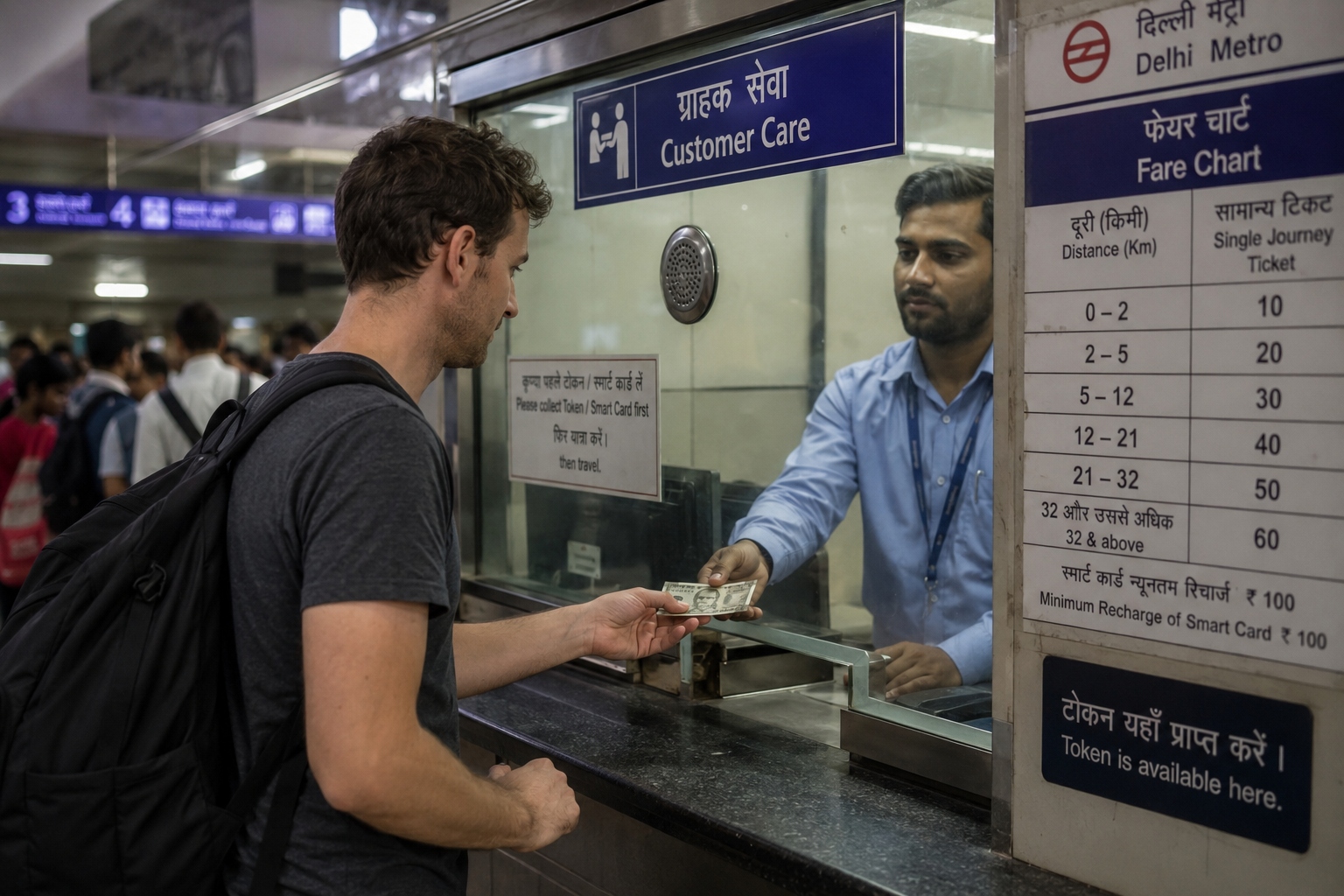
There are three ways to pay for the Delhi Metro. Which one works best depends on how long you’re in Delhi and how often you plan to ride.
Single Journey Token
A small plastic token valid for one trip. You can buy it at the ticket counter or from vending machines at any station. Fares start around ₹10 and go up based on distance. The token lets you through the gate on entry and gets deposited at the exit gate. Good for one-off trips, but if you’re moving around a lot during the day, you’ll be queuing repeatedly.
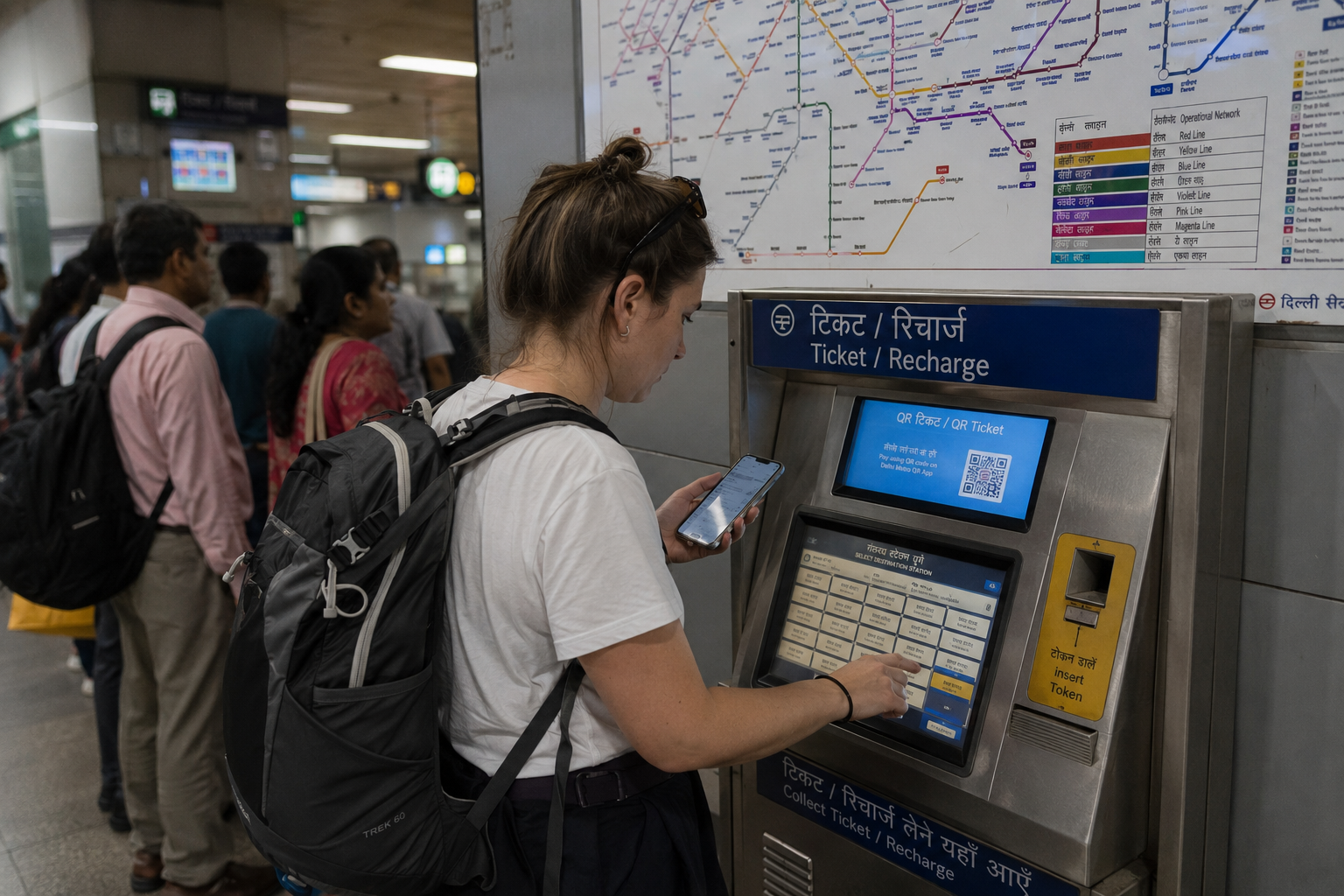
Tourist Card (Recommended for Visitors)
This is the most useful option for tourists. A Tourist Card gives you unlimited travel on all Delhi Metro lines for a fixed period. You buy it at the customer care counter, not the vending machine.
| Card Type | Validity | Cost | Note |
|---|---|---|---|
| 1-Day Tourist Card | 1 Day | ₹200 | ₹150 travel + ₹50 refundable deposit |
| 3-Day Tourist Card | 3 Days | ₹500 | ₹450 travel + ₹50 refundable deposit |
The Tourist Card does not cover the Airport Express Line. That line has a separate fare system. Return the card when you leave and you’ll get the ₹50 deposit back.
Regular Smart Card
A rechargeable card you tap in and out with. Useful if you’re staying in Delhi for a week or more, since you get a small discount on each journey. You can top it up at vending machines or online via the DMRC portal. For most tourists on a short trip, the Tourist Card is simpler.
Understanding the Color-Coded Lines
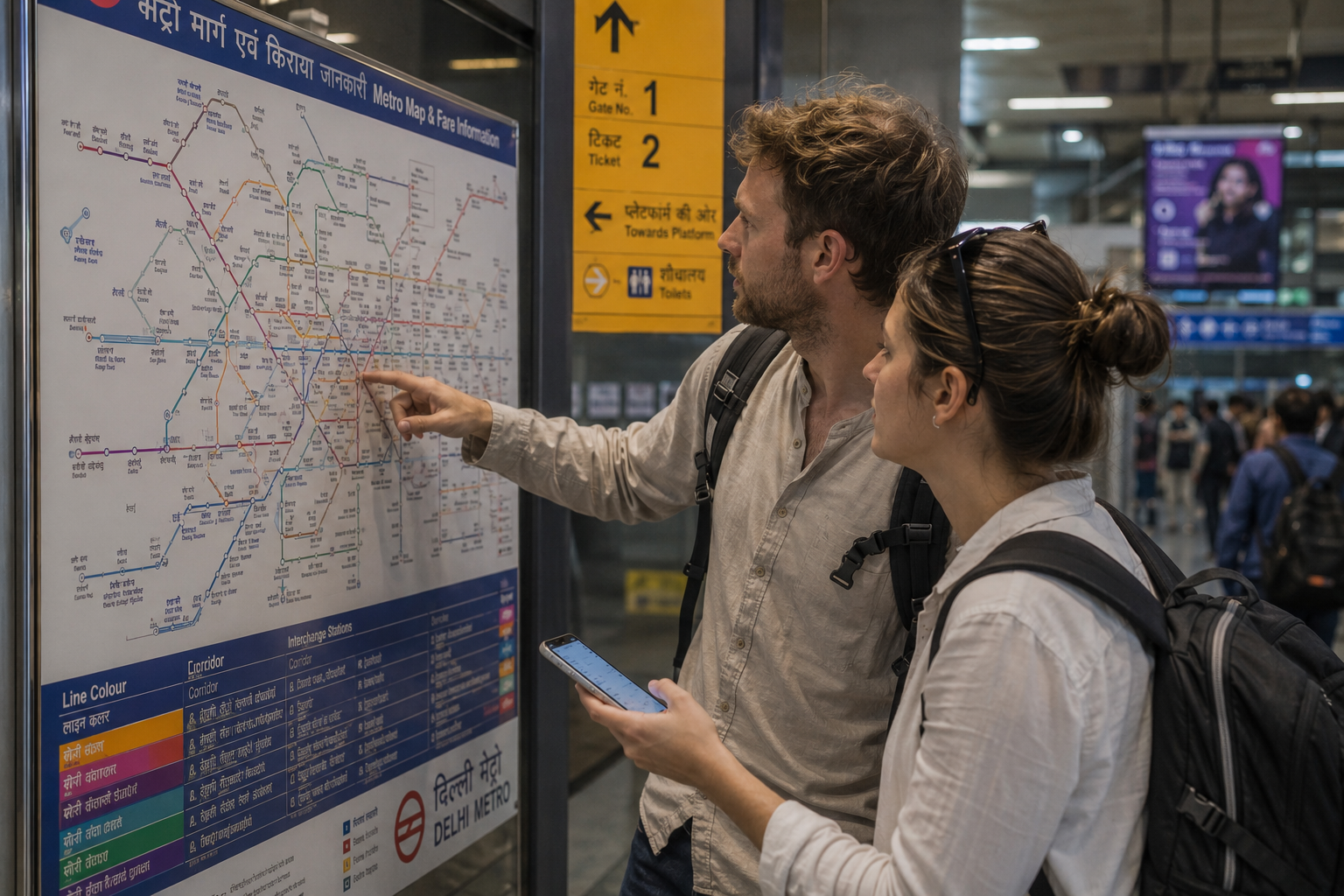
Each Delhi Metro line has a color and a name. As a tourist, you’ll most commonly use the Yellow Line, the Blue Line, and the Airport Express (Orange Line). The others matter depending on where you’re staying and what you want to see.
- Yellow Line Runs from Samaypur Badli in the north to HUDA City Centre in the south, passing through Chandni Chowk, New Delhi, Rajiv Chowk, and Hauz Khas. This is the spine of tourist Delhi.
- Blue Line Connects Dwarka in the west to Noida/Vaishali in the east, passing through Rajiv Chowk, Mandi House, Pragati Maidan, and Akshardham. Major interchange with the Yellow Line at Rajiv Chowk.
- Airport Express (Orange) Dedicated fast line between New Delhi station and IGI Airport Terminal 3 via Aerocity. Completely separate ticketing.
- Magenta Line Connects Janakpuri West to Botanical Garden (Noida), stopping at Hauz Khas and IGI Airport Terminal 1. Useful for south Delhi neighborhoods.
- Violet Line Runs from Kashmere Gate to Raja Nahar Singh (Ballabhgarh), with stops at Khan Market, JLN Stadium, and Nehru Place.
- Green Line Covers west Delhi neighborhoods less relevant for most tourists but useful if you’re staying in Punjabi Bagh or Inderlok.
- Pink Line A ring-style line connecting Majlis Park to Shiv Vihar, useful for getting between south and east Delhi without going through the center.
Directions on Delhi Metro are announced by the terminal station name, not compass direction. So before you board, check your line’s map and identify which end-station your direction of travel is heading toward.
The Security Check: What to Expect
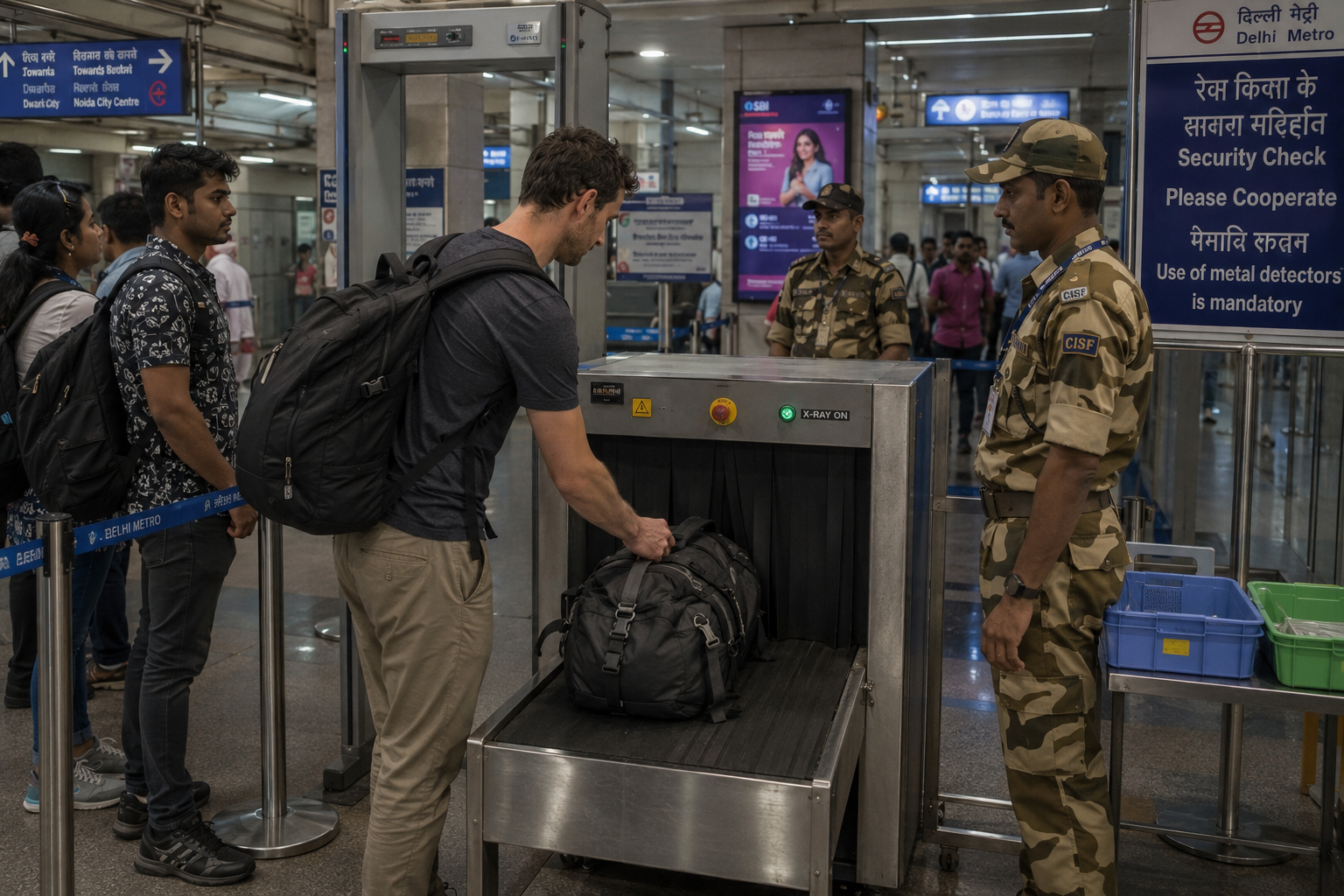
Every Delhi Metro station has a security checkpoint at the entrance. You’ll pass your bag through an X-ray scanner, walk through a metal detector, and occasionally get a pat-down. This is carried out by CISF (Central Industrial Security Force) personnel and it’s mandatory for everyone, every time.
Keep your bag easily accessible so you’re not fumbling at the scanner. Liquids, food, and normal tourist gear are generally fine. Sharp objects and large flammable items are not permitted. The process is quick at smaller stations and can take 3 to 5 minutes at busy interchange stations during peak hours.
Navigating on Your Phone
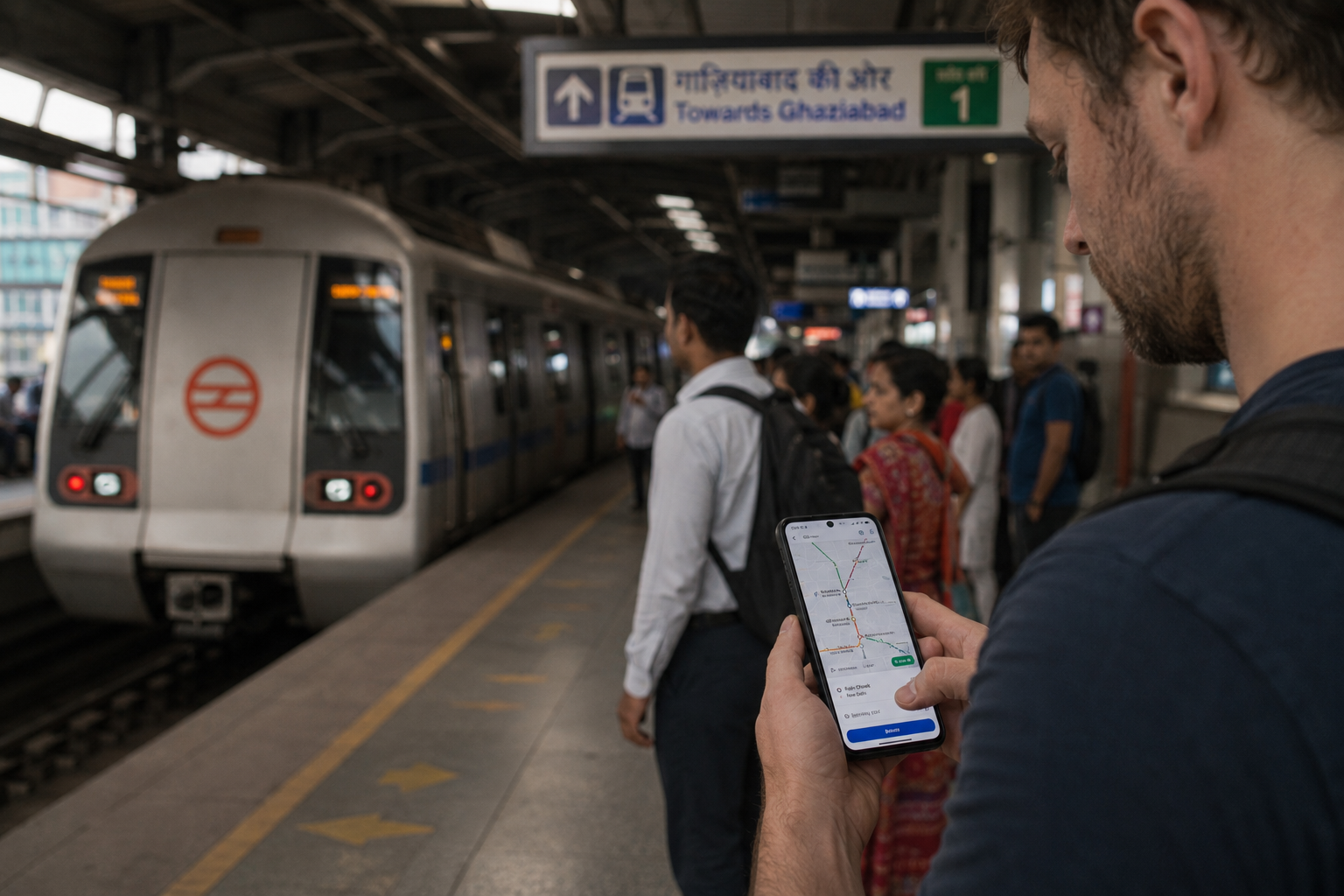
Google Maps works reliably for Delhi Metro navigation. Type your destination, select “transit,” and it will show you which line to take, where to interchange, and how long the journey takes. The Delhi Metro app (Delhi Metro Momentum 2.0) also lets you buy QR code tickets directly, plan routes, and access smart lockers at over 50 stations if you need to stash luggage.
Keep your phone data active or download an offline metro map before you head out. The official DMRC website also has a clean, printable PDF map worth saving to your camera roll.
Getting from the Airport to the City
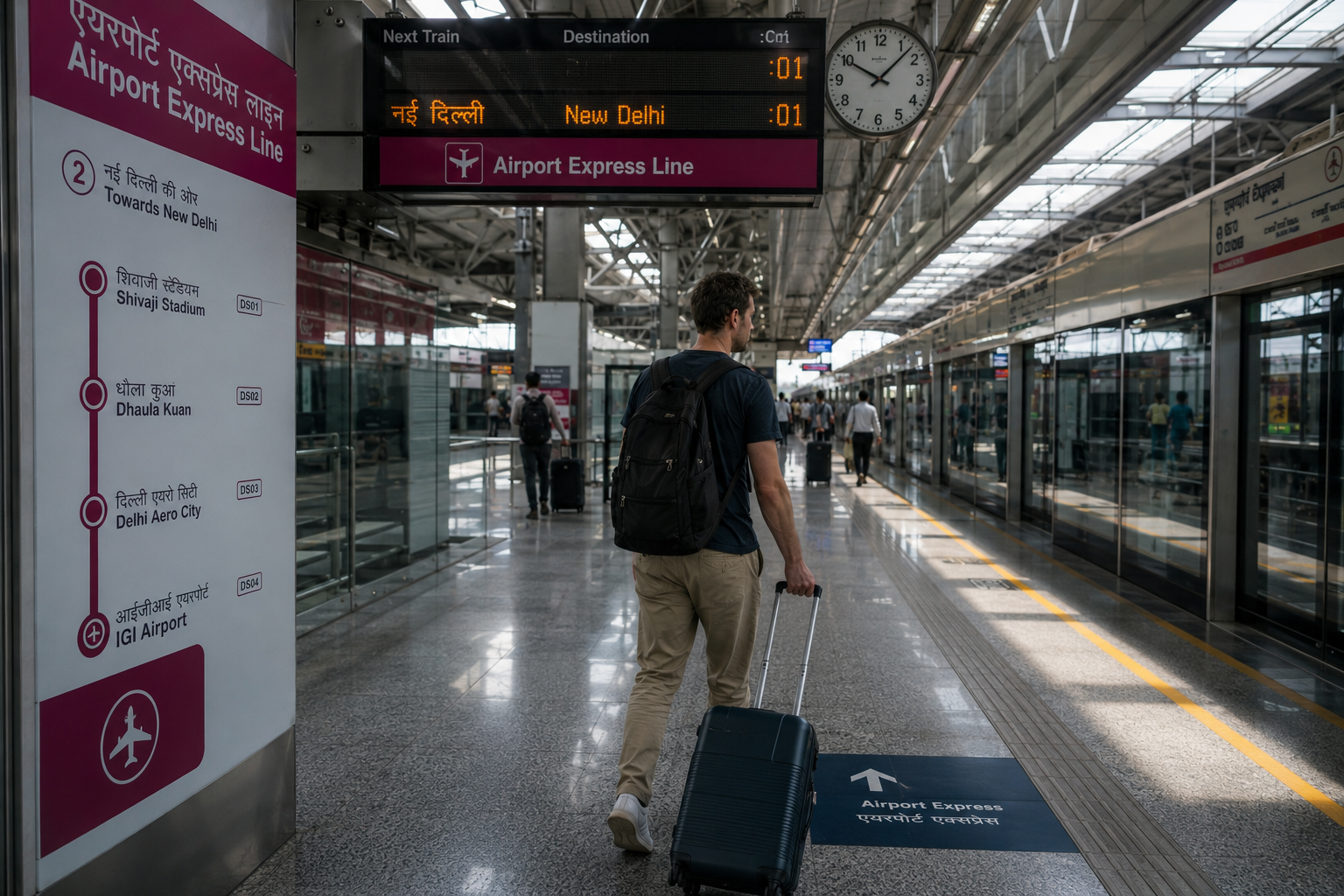
The Airport Express Line (Orange Line) is the fastest way to get from IGI Airport into the city. It runs between New Delhi Railway Station and Terminal 3 in about 20 minutes, with a stop at Aerocity along the way. The fare is separate from the regular metro network and is priced higher than standard lines, somewhere in the range of ₹60 for the full journey, but it’s worth it.
The Airport Express operates from around 4:45 AM to 11:30 PM, which covers most arrival and departure windows. If you land at Terminal 1 (used mainly by domestic carriers), take the Magenta Line from the IGI Airport Terminal 1 station instead. Aerocity also has a feeder bus connecting to Terminal 1 for those who arrive at Terminal 3 and need to transfer.
The Airport Express Line is not covered by the Tourist Card. Buy a separate token or use the Delhi Metro app to purchase a QR ticket for this line specifically.
Rush Hours and What They Actually Feel Like
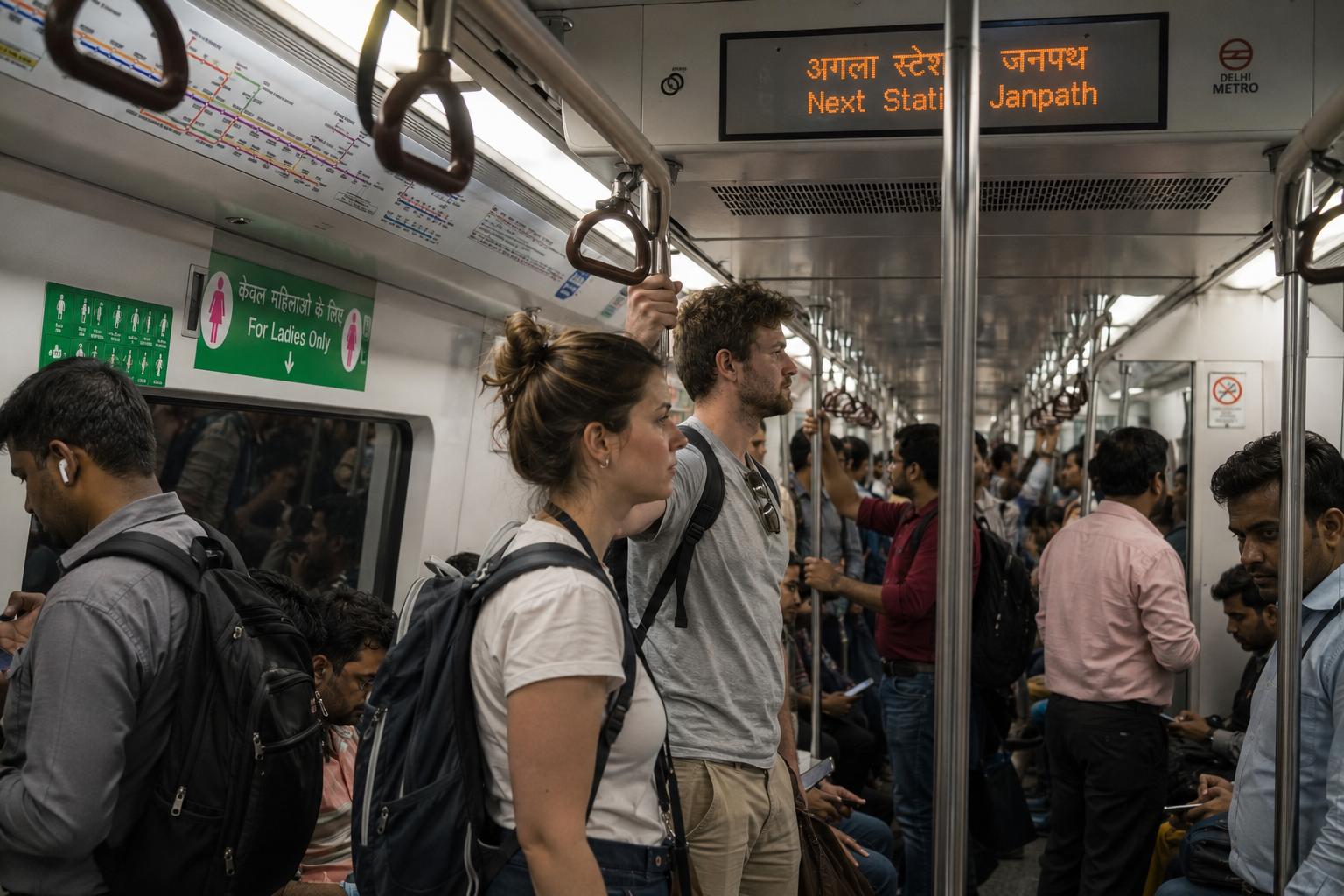
Morning peak runs roughly from 8:30 AM to 11 AM, and evening peak from 6 PM to 8:30 PM. During these windows, major interchange stations like Rajiv Chowk and Hauz Khas get extremely crowded. You may not get onto the first train that arrives. The platforms fill up fast, and the compartments can get tightly packed.
If you have flexibility, start sightseeing early (most major monuments open at 7 AM) and plan your metro rides outside peak windows. The difference in comfort is significant. If you have no choice but to travel during rush hour, keep your bag in front of you, hold your phone securely, and expect to stand for the entire journey.
Women’s Coaches: What You Should Know
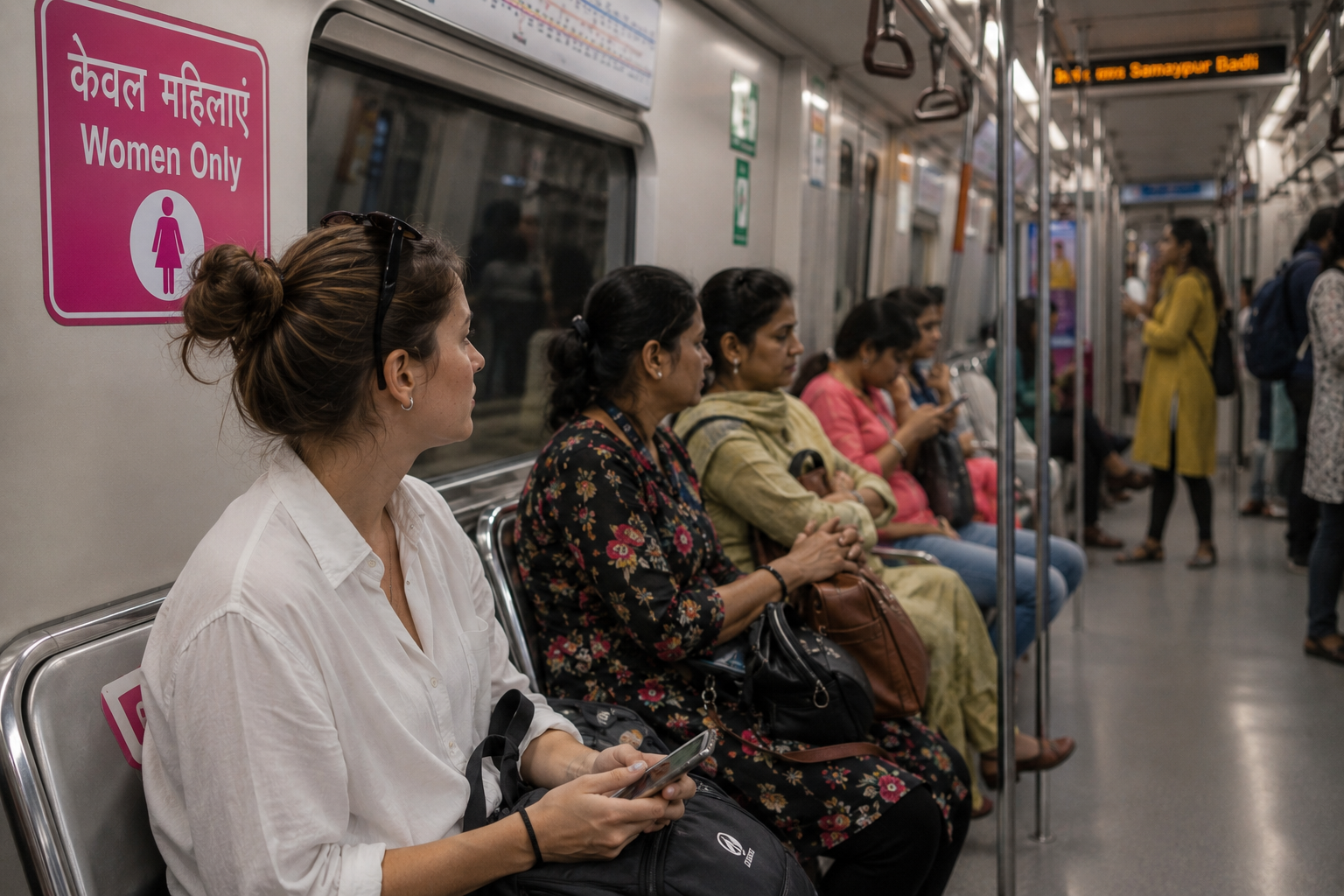
Every Delhi Metro train has a dedicated women-only coach. It’s always the first coach in the direction the train is moving, and it’s marked clearly in pink on the platform. Female travelers can choose this coach at any time of day, and it’s generally less crowded than the general compartments, especially during peak hours.
Men are not permitted in the women’s coach. If a male traveler boards by mistake, he’ll typically be asked to move by other passengers or metro staff. Solo women travelers frequently find this coach more comfortable for longer journeys, and for international visitors who may feel a bit unsure about crowded public transport in a new city, it’s a good option to know about.
Is the Delhi Metro Safe at Night?
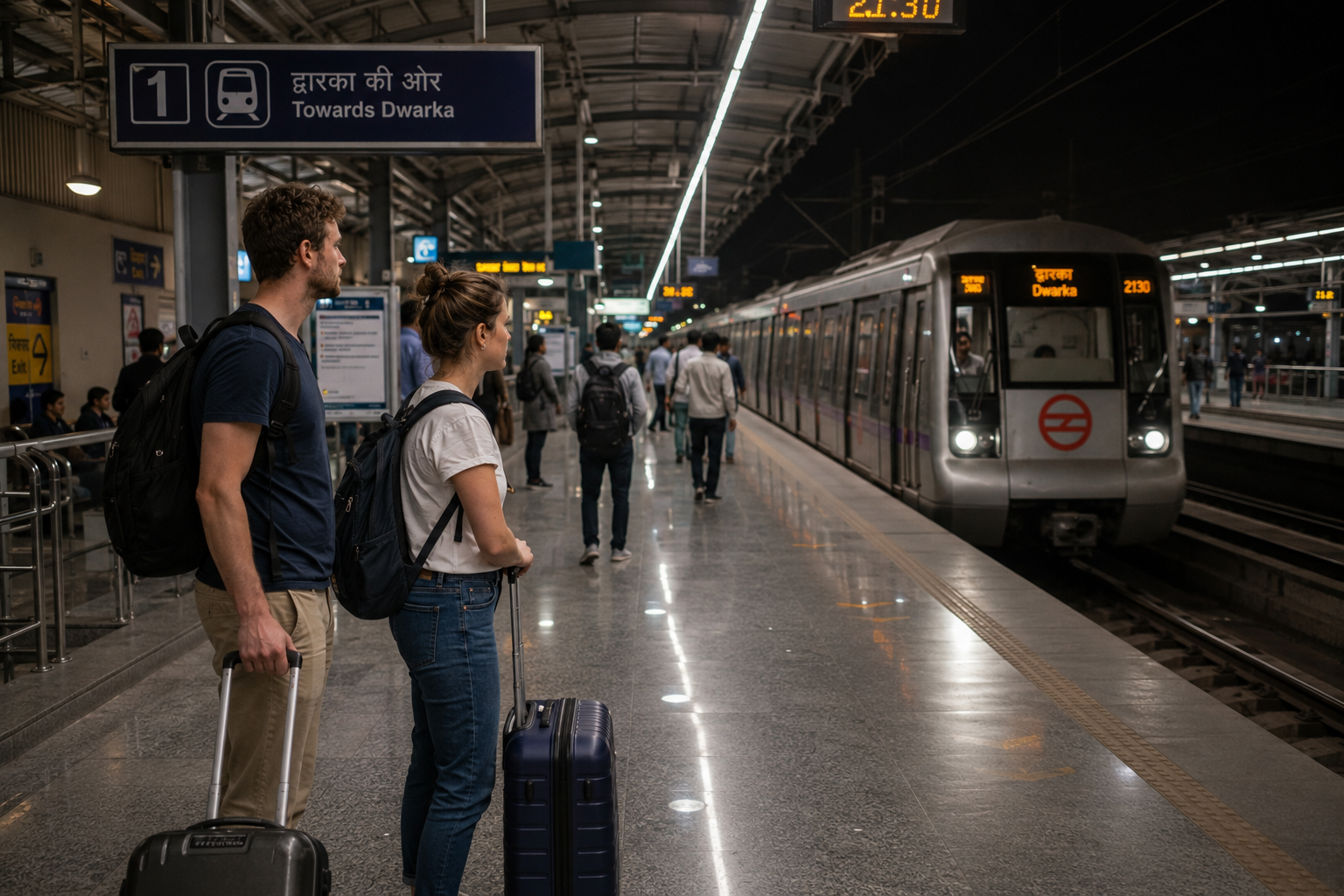
The metro runs until around 11 PM on most lines, and the last trains are generally quieter and well-lit. The stations themselves are monitored by CISF and have CCTV throughout. For most tourists, evening metro travel feels safe and uneventful.
The more practical concern is what happens after you exit. Some metro stations exit onto streets that are poorly lit or lack reliable auto/cab options late at night. If you’re returning from dinner or a late experience somewhere, have your cab app open and know your exit gate before you leave the platform. That small bit of pre-planning avoids unnecessary confusion in the street.
Best Metro Stations for Sightseeing
Delhi’s major tourist sites are well distributed across the metro network. Here’s a practical reference:
| Station | Line | What’s Nearby |
|---|---|---|
| Chandni Chowk | Yellow | Red Fort, Jama Masjid, Sis Ganj Gurudwara, Spice Market, Old Delhi food lanes |
| Rajiv Chowk | Yellow Blue | Connaught Place, Bangla Sahib Gurudwara, Jantar Mantar, Janpath market |
| Central Secretariat | Yellow Violet | India Gate, Rashtrapati Bhawan, National Museum, Lodhi Garden, Safdarjung’s Tomb |
| Qutab Minar | Yellow | Qutub Minar complex (10 min walk from gate 2) |
| Akshardham | Blue | Akshardham Temple |
| Khan Market | Violet | Khan Market shops and cafes, India International Centre |
| Hauz Khas | Yellow Magenta | Hauz Khas Village, restaurants, boutiques, Deer Park |
| Nehru Place | Violet | ISKCON Temple, Lotus Temple, Kalkaji Temple |
| Pragati Maidan | Blue | Humayun’s Tomb, Crafts Museum, National Science Centre |
| Chattarpur | Yellow | Chattarpur Temple complex |
Where to Stay for Good Metro Access
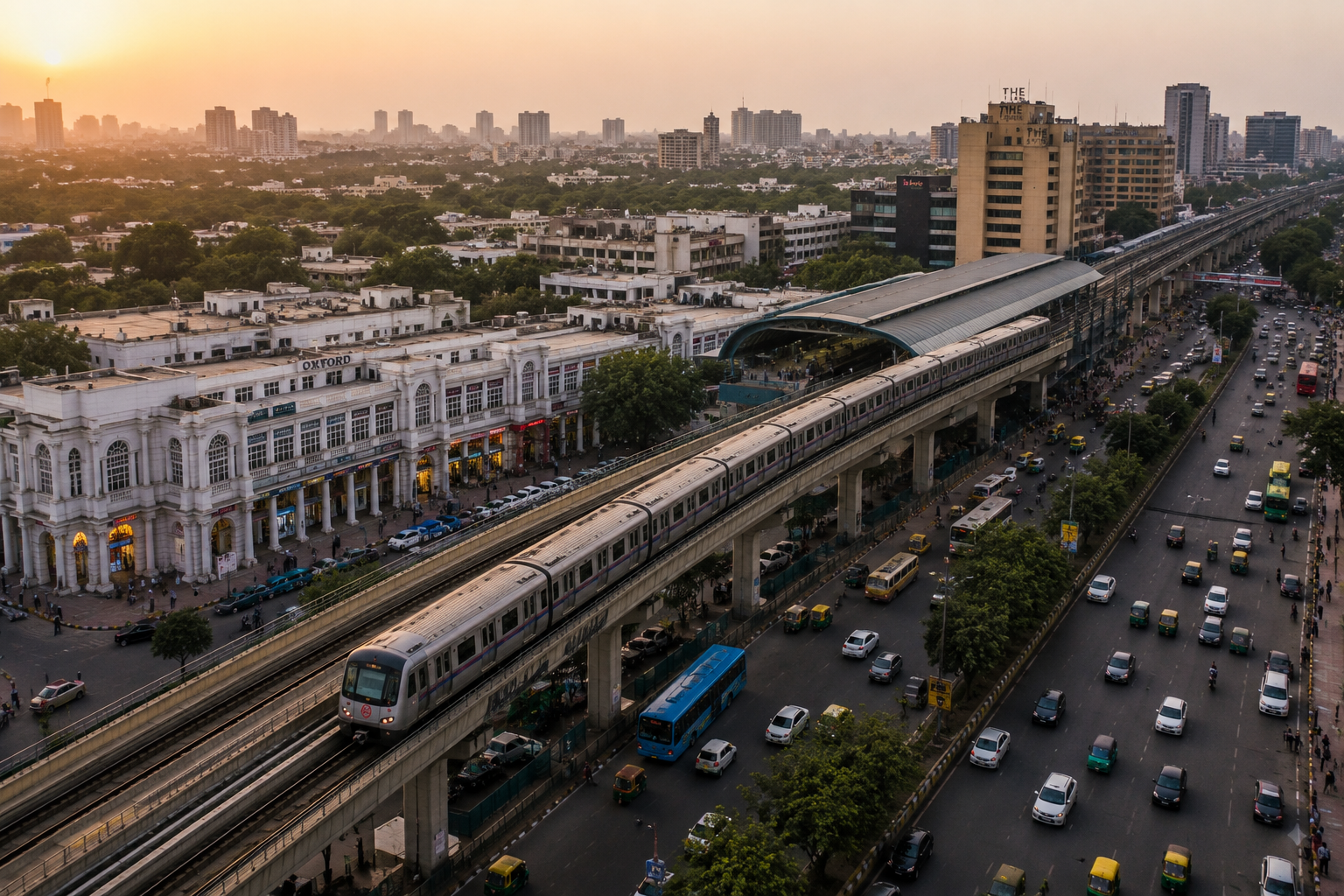
Where you stay in Delhi directly affects how useful the metro is for you. Neighborhoods with strong metro access mean you can move around the city with minimal reliance on autos or cabs.
- Paharganj / New Delhi Station area — on the Yellow Line, central location, popular with budget travelers, close to Old Delhi
- Connaught Place (CP) — Rajiv Chowk station, two lines, easy access to most of the city, mid-range to upscale hotels
- Karol Bagh — on the Blue Line, good connectivity, lots of mid-range hotels and guesthouses
- Aerocity — directly on the Airport Express, good for early departures or late arrivals, business-oriented hotels
- South Delhi (Hauz Khas, Green Park, Malviya Nagar) — Yellow and Magenta Lines, quieter neighborhoods, good for longer stays
- Lajpat Nagar / South Extension — Violet Line, good for shopping areas, moderate connectivity to central Delhi
Key Metro Rules to Know Before You Board
The metro has some rules that are enforced with fines, not just politely ignored. Knowing them avoids awkward moments.
- No eating or drinking inside trains or on platforms. Water is technically allowed, but food is not. Fines are issued.
- No photography inside certain stations, especially near security areas. On the train itself, general photography is usually fine.
- Bags must go through the X-ray scanner without exception, including small purses.
- Lighters and matches are technically prohibited but small pocket lighters are often overlooked. Don’t push this if you have several on you.
- Give up priority seats near the doors for elderly passengers, pregnant women, and people with disabilities.
- Keep the card or token on you through the entire journey. You need it to exit, not just to enter.
Final Thoughts on Getting Around Confidently
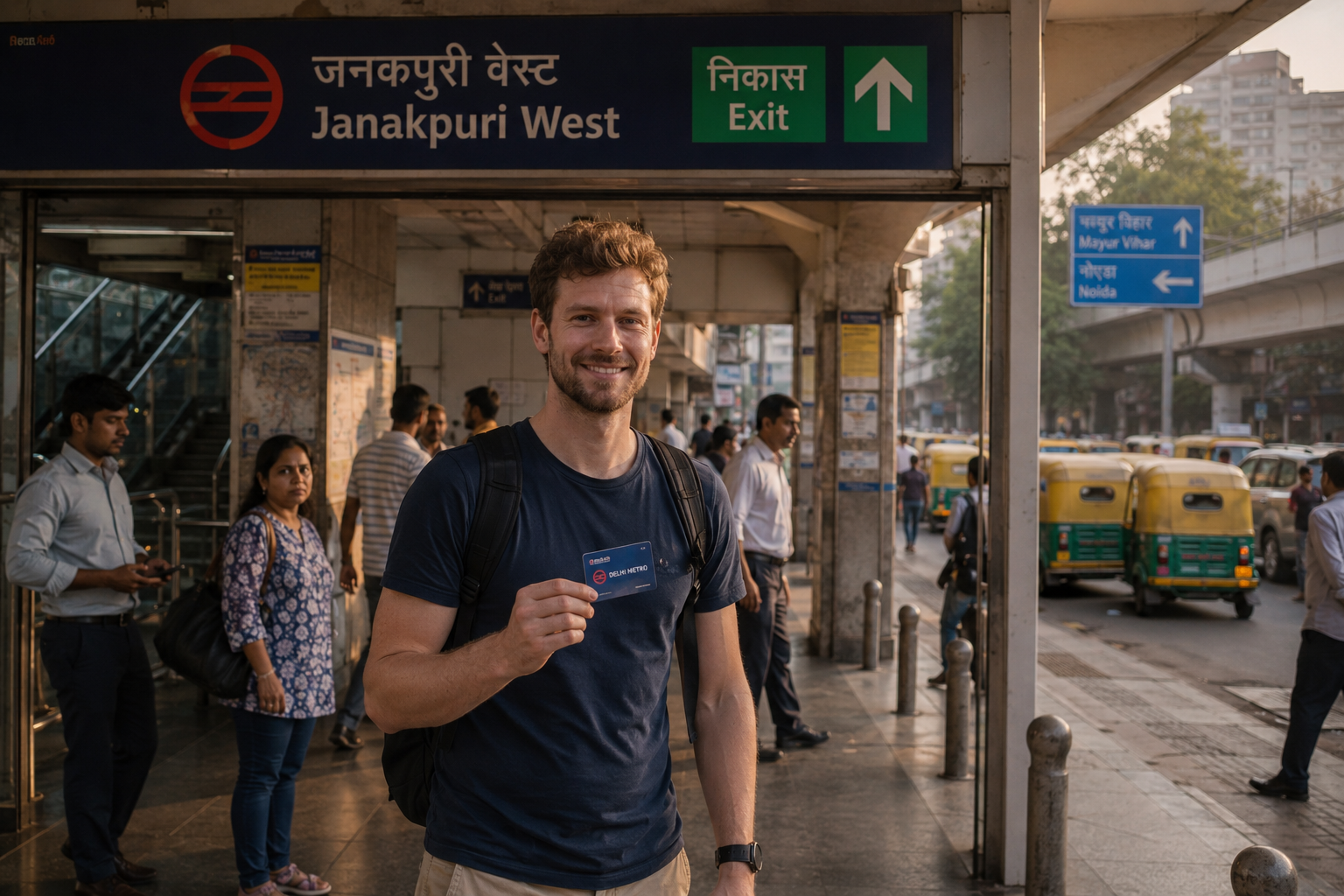
The Delhi Metro is genuinely one of the better urban transit systems in Asia. It’s clean, consistent, affordable, and gets you close to nearly everything worth seeing in the city. The learning curve is short. Spend 15 minutes with the map before your first day, buy a Tourist Card, and you’ll have the city’s most practical transport tool sorted.
Most of the challenges tourists face in Delhi, such as unpredictable traffic, overpriced cabs, and negotiating with auto drivers, simply disappear when you’re on the metro. That’s worth more than it sounds on a busy travel day.
Explore Delhi with a Local Guide
The metro gets you there. Our experiences take you deeper. Browse our most popular Delhi tours and day trips below.
Frequently Asked Questions
Is the Delhi Metro safe for tourists?
Yes. The Delhi Metro has CISF security at every station, CCTV throughout, and consistent enforcement of rules. It’s one of the safest ways to travel around the city. Women-only coaches add an extra layer of comfort for female travelers.
How do I get from Delhi Airport to the city center by metro?
Take the Airport Express Line (Orange Line) from Terminal 3 to New Delhi station. The journey takes about 20 minutes and costs around ₹60. This line has separate ticketing and is not covered by the Tourist Card. For Terminal 1, use the Magenta Line from the IGI Airport Terminal 1 station.
What is the Delhi Metro Tourist Card and how much does it cost?
The Tourist Card gives unlimited travel on all Delhi Metro lines (except the Airport Express) for 1 or 3 days. The 1-day card costs ₹200 (including a ₹50 refundable deposit) and the 3-day card costs ₹500. Buy it at the customer care counter, not the vending machine.
Which metro line goes to Chandni Chowk and Old Delhi?
The Yellow Line stops at Chandni Chowk station, which is the main entry point for Old Delhi, the Red Fort, Jama Masjid, and the spice market at Khari Baoli. It’s a 5 to 10 minute walk from the station to most Old Delhi attractions.
Can I use Google Maps to navigate the Delhi Metro?
Yes, Google Maps is reliable for Delhi Metro route planning. Select transit directions, and it will show you which line to take, where to interchange, and estimated travel times. The Delhi Metro app (Momentum 2.0) also allows in-app QR ticket purchases.
What are the Delhi Metro operating hours?
Most metro lines run from 6:00 AM to 11:00 PM. The Airport Express Line runs from 4:45 AM to 11:30 PM. Exact timings vary slightly by line and station, so check the DMRC website for specific first and last train times on your route.
Can I eat or drink on the Delhi Metro?
No. Eating and drinking inside trains and on platforms is prohibited and subject to fines. This includes snacks and street food, even if you’ve just bought it outside the station. Water is generally tolerated but food is not.
Which metro station is closest to India Gate?
Central Secretariat on the Yellow Line is the most convenient station for India Gate. From there it’s about a 15 minute walk or a short auto ride. The station also gives easy access to the National Museum, Lodhi Garden, and Rashtrapati Bhawan.
Is the Delhi Metro easy to use if I don’t speak Hindi?
Yes. All station signage, announcements, and route maps are in English as well as Hindi. The ticket vending machines have an English interface. Most station staff speak at least basic English. For tourists, the language barrier on the metro is minimal.
What should I do if my metro card stops working?
Go to the Customer Care counter at the station. They can check and reset the card. For quicker service, try a smaller, less busy station rather than a major interchange like Rajiv Chowk during peak hours.
You Might Also Like
- Old Delhi Food & Cultural Experience Tour
- Delhi’s Best Street Food Beyond Old Delhi
- Street Art Walk: Lodhi Gardens with Chai
- Learn the Art of Indian Cooking (6 Dishes)
- Chai Master Class in an Indian Family Home
- Luxury Old Delhi Street Food Tasting
- Delhi to Taj Mahal Day Trip
- Same Day Jaipur Tour from New Delhi
- India’s Golden Triangle in 7 Days